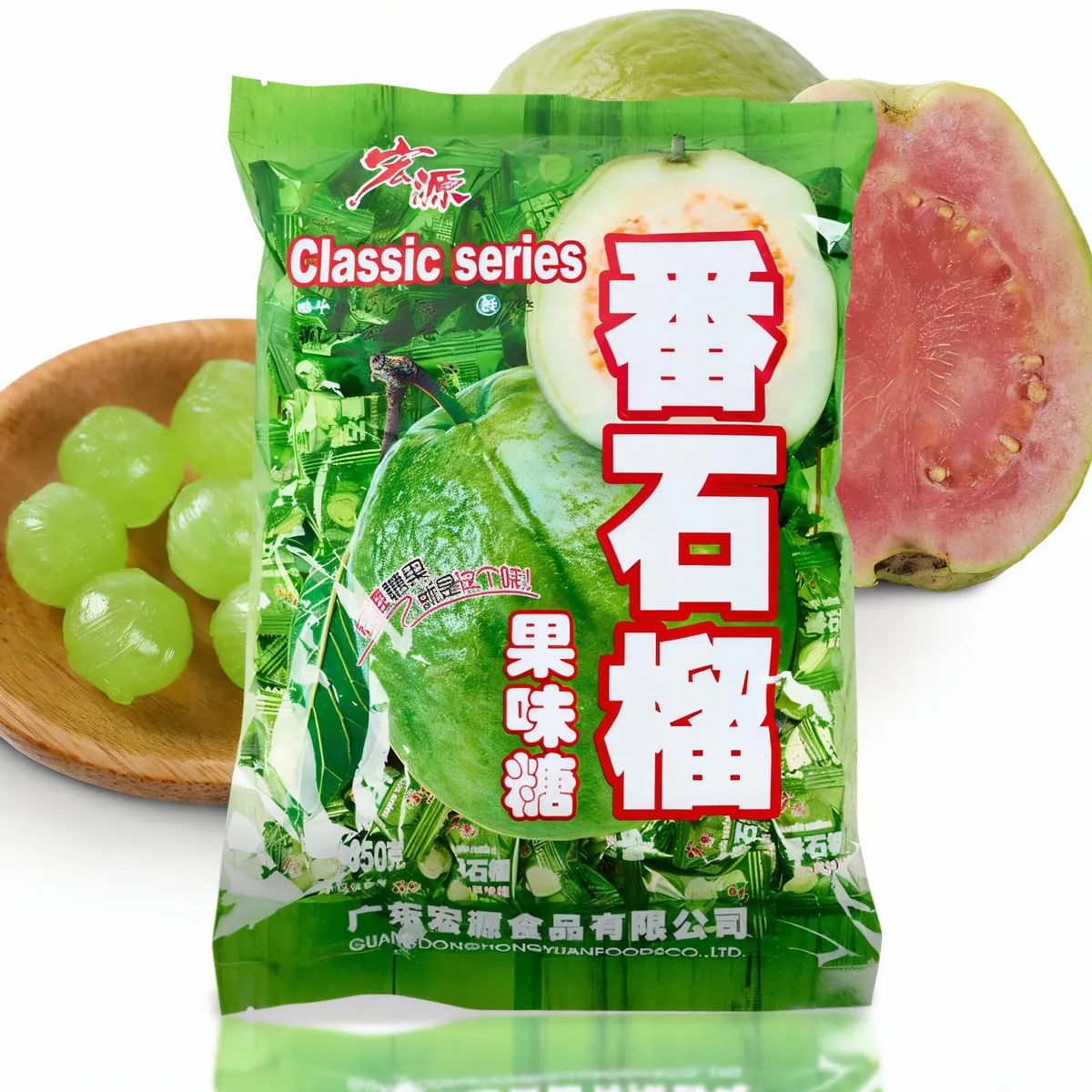
Hongyuan Guava Candy Pack Sizes: What One Bag Costs in Each
The same 350 g bag sells in several packs, and the price of one bag changes with each. The arithmetic, a party planner and storage advice.
A bag of Hongyuan candy carries a Chinese print and an importer's English sticker. Here is what each line of that sticker says, and where it slips.
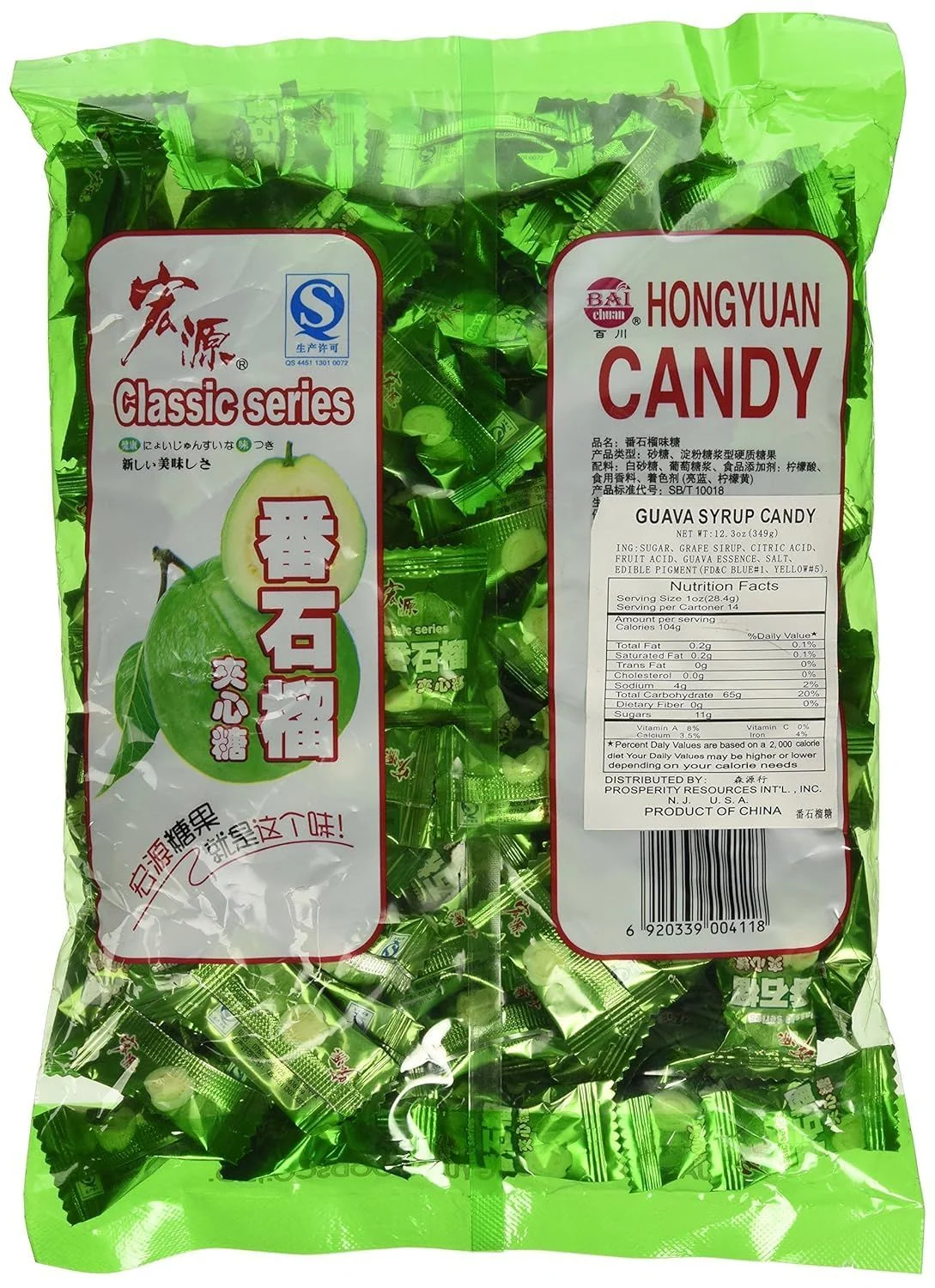
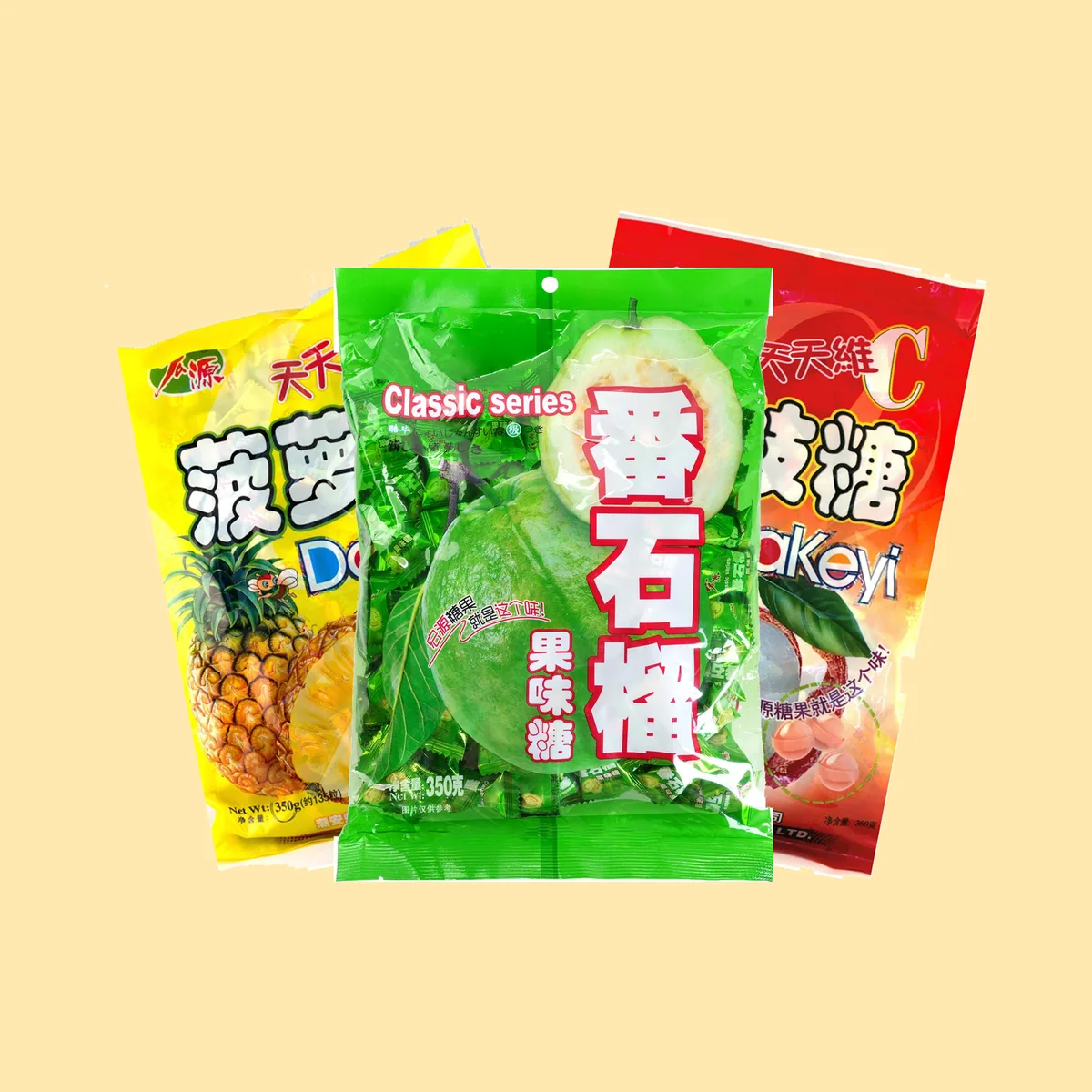
A Hongyuan bag sold in the United States speaks twice. The factory prints the front and back in Chinese. Then an importer adds a white sticker in English with the name of the candy, the ingredients and a Nutrition Facts panel.
On the guava bag that sticker reads Hongyuan Candy, Guava Syrup Candy. It gives the net weight as 12.3 oz (349 g), names a distributor in New Jersey and ends with the words Product of China. Everything an American buyer can check is on that small rectangle.
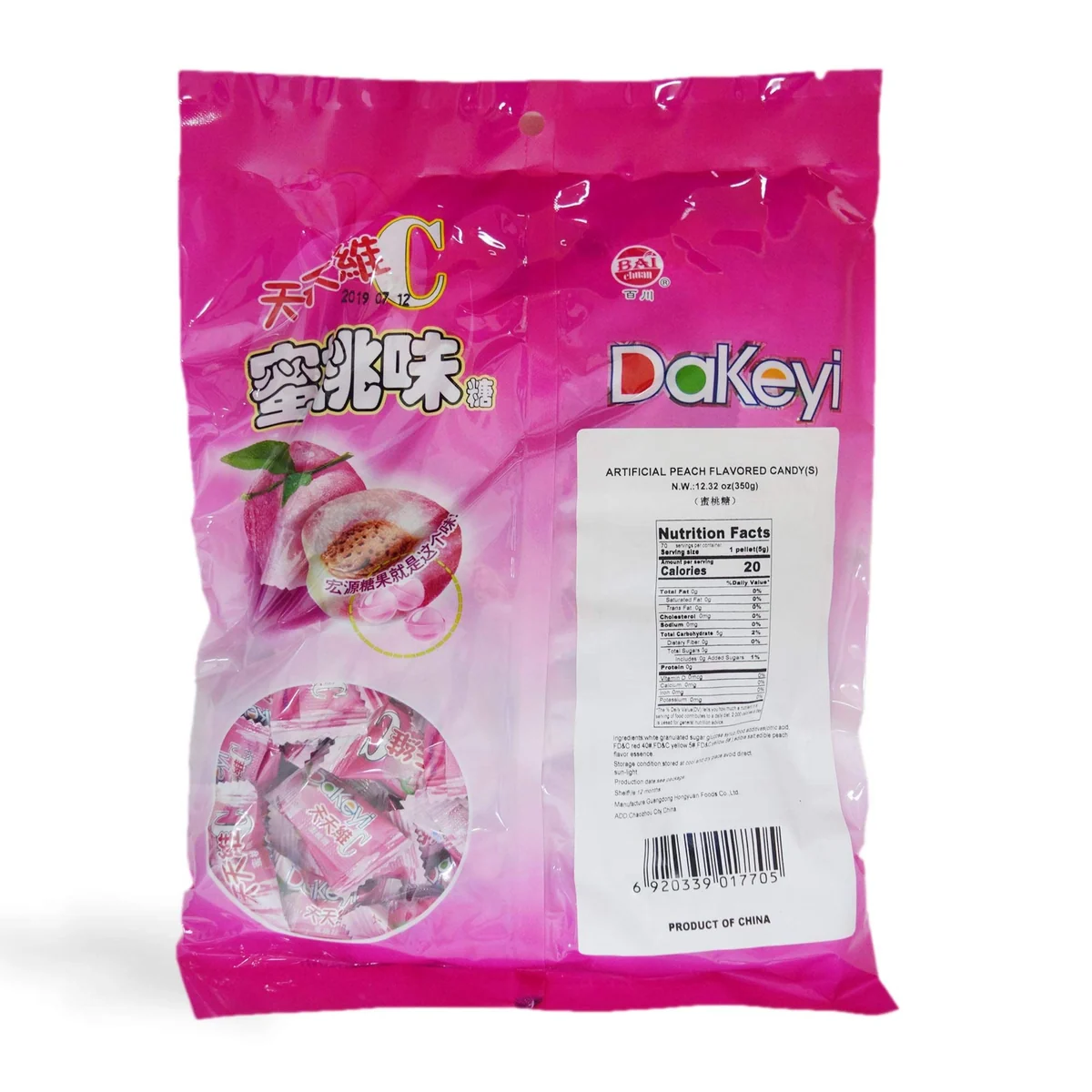
Stickers are not all alike. More than one importer's label turns up on these bags, and the peach bag even carries two that count a serving differently. Two bags of the same flavor can carry different wording, and one may be more careful than the other. Read the bag you hold.
The order of an ingredient list is not a matter of style. Federal rules fix it.
The FDA requires food manufacturers to list all ingredients on the label, with the ingredients used in the greatest amount first, followed in descending order by those in smaller amounts.
So the first word tells you what the candy mostly is. On both Hongyuan labels that word is sugar. The guava list runs to 8 entries and the peach list to 7, and the dyes come last on each, which makes them the smallest part of the recipe.

| Ingredient | Its job | Guava label | Peach label |
|---|---|---|---|
| Sugar | The body of the candy and most of its sweetness | First on the list | First on the list |
| Glucose syrup | Stops the sugar from turning back into crystals | Second, misspelled | Second |
| Citric acid | The sour edge of a fruit candy | Third | Fourth |
| Flavoring | The taste of the fruit | Guava essence | Artificial peach flavor |
| Salt | Rounds off the sweetness | Sixth | Not on this list |
| Color | Tells one flavor from another | Blue 1 and Yellow 5 | Red 40, Yellow 5, Yellow 6 |
Six jobs, and sugar does the biggest one. A hard candy is a simple thing. The skill is in the cooking, not in the length of the list.
It is glucose syrup, misspelled. The Chinese ingredient line printed on the same bag names glucose syrup in second place, right where the English sticker says grafe sirup, the second of its 8 entries.
The slip is the importer's, and it is harmless once you know. Glucose syrup is the quiet partner in nearly every hard candy. Without it the boiled sugar would turn cloudy and gritty as it cooled.
It contains long chains of glucose molecules that tend to keep the sucrose molecules in the lollipop syrup from crystallizing.
American recipes use corn syrup for the same job. The candy science is identical: long chains of glucose get between the sugar molecules and keep the candy clear as glass. That glassy look is how you know the syrup did its work.
Sugar alone tastes flat. A fruit candy needs something sour to stand in for the sharpness of real fruit, and citric acid is the usual choice.
It's also what gives fruits such as lemons and limes their sour taste.
The guava sticker lists a second souring agent and calls it fruit acid. It does not say which acid that is. The peach label makes do with citric acid alone.
Salt appears on the guava list and not on the peach one. In a candy it is not there to taste salty. A small amount makes sweetness seem rounder, the same way a pinch does in cookie dough.
The two labels name their flavorings in different ways. Peach uses the legal term: artificial peach flavor. Guava uses a word of the importer's own: guava essence.
The term natural flavor or natural flavoring means the essential oil, oleoresin, essence or extractive, protein hydrolysate, distillate, or any product of roasting, heating or enzymolysis
The word essence does appear in the legal definition of a natural flavor. But the sticker does not use the full legal phrase, so it tells you less than it seems to. It says the candy tastes of guava. It does not say where that taste was made.
The peach label leaves no such doubt, and puts the word artificially in capitals on the front. If the source of a flavor matters to you, peach is the bag with the clear answer.
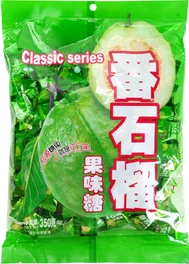
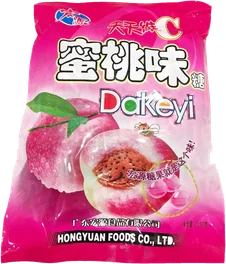
Guava candy is green because of two dyes, Blue 1 and Yellow 5. Blue and yellow make green, in candy as in paint. The peach candy takes three: Red 40, Yellow 5 and Yellow 6. All of them are certified colors, and the label must name each one.
Each certified color additive is required to be declared on product labels by its listed name or by a shortened form of its name, consisting of just the color and number, such as Yellow 6.
| Dye | On which bag | How it must be declared | On the FDA list for removal by the end of 2027 |
|---|---|---|---|
| FD&C Blue 1 | Guava | By its listed name or the short form | Yes |
| FD&C Yellow 5 | Guava and Peach | By name, under its own federal rule | Yes |
| FD&C Red 40 | Peach | By its listed name or the short form | Yes |
| FD&C Yellow 6 | Peach | By its listed name or the short form | Yes |
Yellow 5 has a rule of its own. Other dyes may go by a short form such as Yellow 6, but this one has to be listed by name wherever it is used.
Foods for human use that contain FD&C Yellow No. 5, including butter, cheese, and ice cream, shall specifically declare the presence of FD&C Yellow No. 5 by listing the color additive as FD&C Yellow No. 5 among the list of ingredients.
The reason is that a small number of people react to it. Both Hongyuan labels name Yellow 5, so anyone who has been told to avoid the dye should pass on guava and peach alike.
The FDA requires all products containing FD&C Yellow No. 5 to identify it on their labels so consumers who are sensitive to the dye can avoid it.
Possibly not. In 2025 the FDA set out to remove 6 certified dyes from American food by the end of 2027, and all 4 dyes on these two labels are on that list.
to eliminate six remaining certified color additives frequently used in the food supply—FD&C Green No. 3, FD&C Red No. 40, FD&C Yellow No. 5, FD&C Yellow No. 6, FD&C Blue No. 1, and FD&C Blue No. 2—by the end of 2027.
What that means for an imported candy is not settled. A factory that sells in many countries may change the recipe for all of them, make a separate version for the United States, or wait. The ingredient line on a new bag is the only reliable signal.
If the dyes do go, expect the candy to look different. Natural colors tend to be softer than certified ones, and the bright glassy green of the guava piece comes from two dyes on that list.
The guava sticker uses the older panel layout. It gives a serving as 1 oz (28.4 g), counts 14 servings to the bag and lists 104 calories a serving. Read slowly, because several of its lines do not agree with each other.
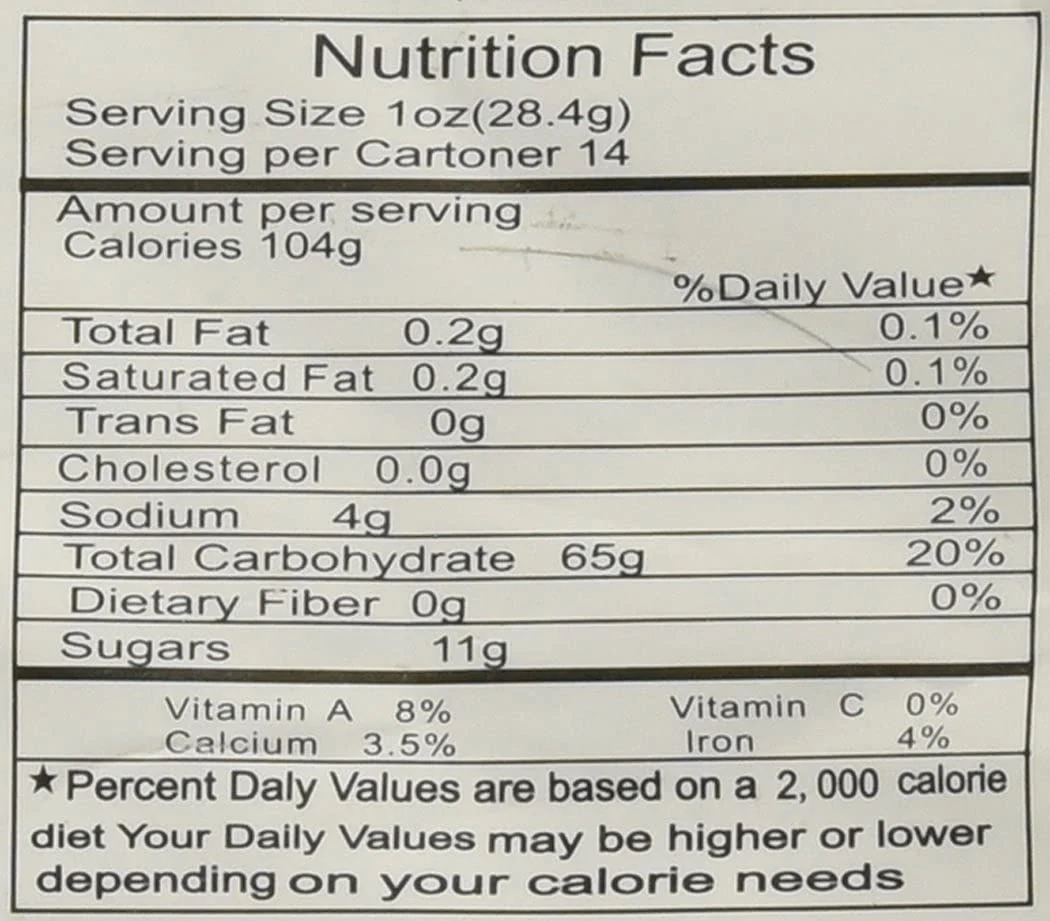
The calorie line is the one to trust, and simple arithmetic shows why.
There are four calories in one gram.
A serving of 28.4 g made of pure sugar would come to 114 calories. The sticker says 104. That is what you would expect from a candy that is almost all sugar with a trace of water, acid and color.
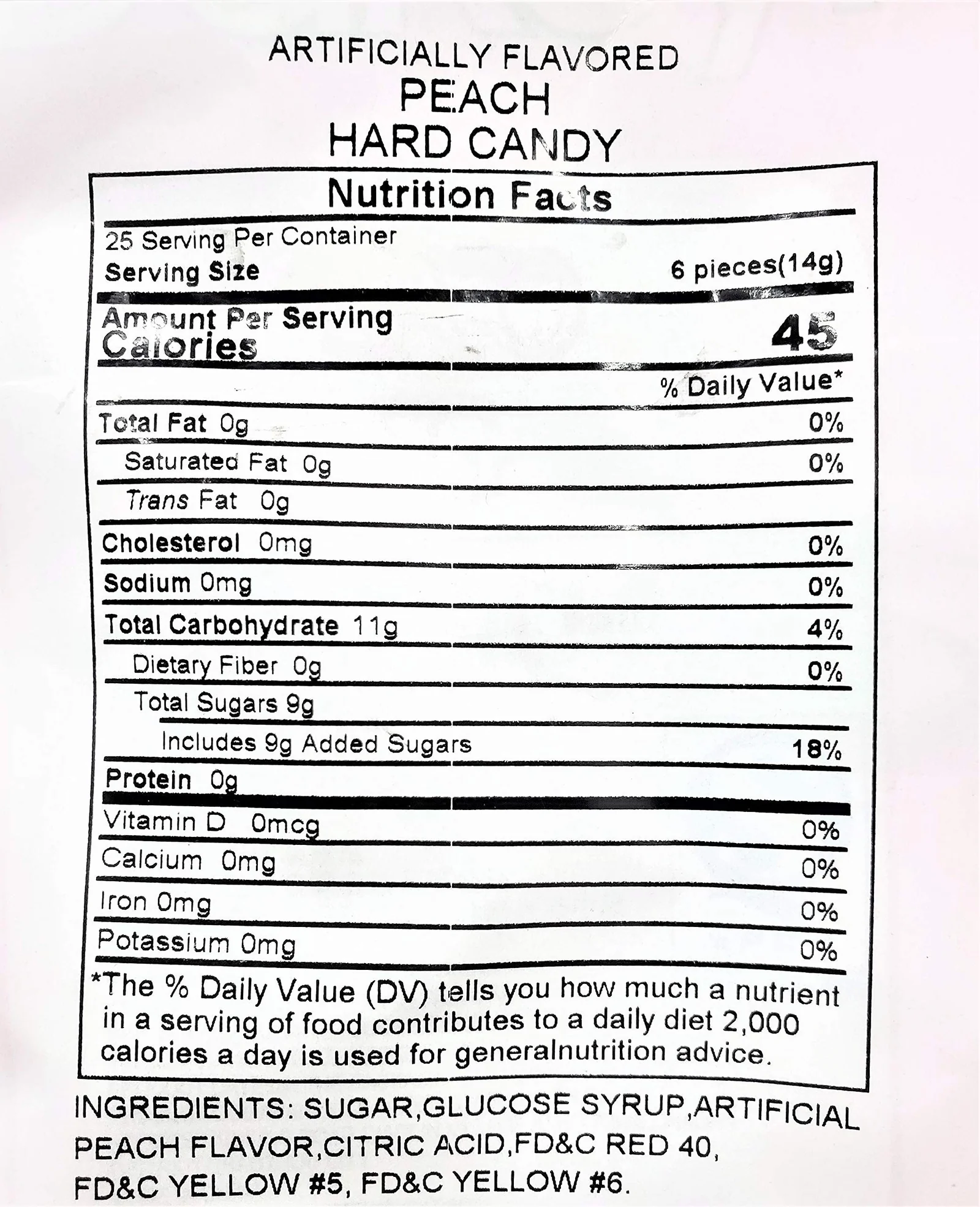
The peach panel is the newer layout, and its numbers hold together. A serving is 6 pieces (14 g). There are 25 servings to the bag, and 25 times 14 g is exactly 350 g. Each serving has 45 calories and 11 g of carbohydrate, of which 9 g is added sugar.
One caution about the word serving. It is a unit for comparing foods, not advice about how much to eat.
It is not a recommendation of how much you should eat or drink.
The peach bag has a puzzle too. A second sticker on the same bag calls a serving 1 piece (5 g) and counts 70 servings and 20 calories each. Six pieces to 14 g means a piece of about 2.3 g, not 5 g. The panel with the full list of nutrients is the more careful of the two, and its piece weight is close to the count printed on the pineapple bag.
| Line | What it tells you | Guava sticker | Peach sticker |
|---|---|---|---|
| Serving size | The amount every other line refers to | 1 oz (28.4 g) | 6 pieces (14 g) |
| Servings per container | How many of those are in the bag | 14, which overshoots the net weight | 25 |
| Calories | Energy in one serving | 104 | 45 |
| Total carbohydrate | Sugars and any other carbohydrate | 65 g, a misprint | 11 g |
| Added sugars | Sugar put in during making | No such line on the older layout | 9 g, 18% of the Daily Value |
| Sodium | Mostly from salt | 4 g, a misprint | 0 mg |
About 1.5 g. The peach panel gives 9 g of added sugars for 6 pieces, and that serving is 18% of the FDA Daily Value.
One piece is small change: 7.5 calories. The trouble with a dish of hard candy is that nobody stops at one. So it helps to know how many pieces it takes to reach the yardsticks that health bodies use.
| Yardstick | Added sugar a day | Pieces to reach it | Calories in those pieces |
|---|---|---|---|
| FDA Daily Value for added sugars | 50 g | 33 | 248 |
| American Heart Association limit for men | 36 g | 24 | 180 |
| American Heart Association limit for women | 25 g | 16 | 120 |
| American Heart Association limit for children | 25 g | 16 | 120 |
The Daily Value for added sugars is 50 grams per day based on a 2,000 calorie daily diet.
The American Heart Association draws its line lower, and lower still for women than for men.
Women should consume no more than 6 teaspoons (25 grams or 100 calories) per day.
By the FDA's own scale, a food with 20% or more of the Daily Value in a serving counts as a high source. A 6-piece serving of peach candy stands at 18%, just under that mark. One more piece carries it over.
Children and adolescents should limit calories from added sugars to ≤25 grams (100 calories or ~6 tsp) per day
For a child that limit is about 16 pieces, with nothing else sweet all day. Candy shares the day with juice, cereal and dessert, so the room left for it is far smaller.
American law singles out nine foods as major allergens, and a label has to name any of them used as an ingredient.
The major food allergens are milk, eggs, fish, Crustacean shellfish, tree nuts, peanuts, wheat, soybeans, and sesame.
Neither Hongyuan list names one of the nine. Sugar, glucose syrup, acids, flavoring, salt and dyes are all there is. That is good news as far as it goes.
It does not go all the way. A list covers ingredients, not the factory. Whether a line also runs milk candy or peanut candy is a question about cross-contact, and labels are not required to answer it.
Such statements are not required by law and can be used to address unavoidable “cross-contact,” only if manufacturers have incorporated good manufacturing processes in their facility
So the absence of a may-contain line proves nothing either way. If an allergy in your house is severe, treat an imported candy with the same caution as any food whose factory you cannot ask.
The ingredient lists name no wheat, rye or barley, and nothing that comes from an animal. Neither bag carries a gluten-free claim or a vegan mark. That is common for candy and does not mean much by itself.
However, because a “gluten-free” claim isn’t required to be on a food package, it may not appear even if the food is, in fact, gluten-free.
For most diets the ingredient list settles the question. For a strict one it does not, because a list is not a certificate. The ingredients page takes the diet questions one by one.
The peach sticker states a shelf life of 12 months. The product information for the guava bag gives 2 years. Neither figure is a federal requirement.
Except for infant formula, product dating is not required by federal regulations.
That explains a complaint in the reviews. One buyer of the peach bag looked for a date and could not find one.
There are no dates on the packaging to know how old the candy is.
A date may still be there in another form. Shelf-stable foods often carry a code in place of a calendar date.
"Closed or coded dates" are a series of letters and/or numbers and typically appear on shelf-stable products such as cans and boxes of food.
When no date can be read, judge the candy itself. A piece that is hard, dry and glassy is in good shape. A piece that is tacky or stuck to its wrapper has taken on moisture, and its best days are behind it. The pack guide has storage advice that keeps a bag in the first group.
No sticker on these bags mentions it, yet it belongs in any careful reading of the label. A Hongyuan candy is small, round and hard, and that shape stands on the CDC's list of choking hazards for young children.
Round or hard candy, jelly beans, caramels, gum drops, or gummy candies.
Buyers notice it themselves. More than one review ends with a warning to other parents.
They are about the size of a marble so please do not give to children, but enjoy them yourself!
Pediatricians put the line at four years. For older children the advice is about how they eat, not what: seated, not running, with an adult nearby.
Insist that children eat at the table or sit down when they eat.
A hard candy takes minutes to finish, and that is its charm. It is also the problem, from a dentist's point of view. The teeth sit in sugar the whole time.
While these hard candies seem harmless, eat too many and the constant exposure to sugar can be harmful to your teeth.
Timing helps. A piece right after a meal does less harm than the same piece an hour later, because the mouth is already making saliva.
If you have a little candy with meals (or right afterward), you’ll benefit from the extra saliva your mouth automatically makes while you’re eating a full meal.
And let it melt. Biting a hard candy in half is how teeth get chipped, and a chipped tooth costs more than every bag in the case.
They are sugary so not good for the teeth or health.
None of the three is alarming. They are the gaps of a small importer's sticker, and the peach label shows what a fuller one looks like. When two bags of the same candy carry different stickers, trust the one whose numbers add up.
This guide reads labels and quotes public sources. It is not medical or dietary advice. For an allergy or a prescribed diet, ask your doctor or a registered dietitian, and check the bag in your hand.
Sources read for this guide
The same 350 g bag sells in several packs, and the price of one bag changes with each. The arithmetic, a party planner and storage advice.
Six fruits, one kind of candy. What each flavor tastes like, where the fruit comes from, what reviewers say and which bag to open first.